Vietnam Industry 2030: Strategy for Quality FDI Attraction
How Does the “New Generation” FDI Strategy Create Industrial Momentum?
The “New Generation” FDI attraction strategy is expected to become an important driver for restructuring, improving the quality, and enhancing the competitiveness of Vietnam’s industrial sector.
The Industrial Landscape of Vietnam The industrial sector always plays a foundational role in the socio-economic development process of every nation. For Vietnam, developing industry towards efficiency, sustainability, environmental friendliness, and effective resource exploitation is identified as a key condition to realize the goal of becoming a developing country with modern industry and upper-middle income by 2030.
2021-2025 Performance: In the first 5 years of implementing the 10-year Socio-Economic Development Strategy (2021–2030), despite adverse international developments and a global economic slowdown, Vietnam’s industrial sector maintained a relatively high growth momentum.
- Growth Rates: In the 2021–2025 period, Vietnam’s economy is estimated to achieve an average growth of about 6.1%/year.
- The Industry and Construction sector reached 6.4%/year.
- Specifically, the Processing and Manufacturing industry reached 7.4%/year.
- Structural Shift: The economy gradually reduced dependence on mineral exploitation and labor-intensive industries, while the proportion of processing and manufacturing increased, shifting towards fields with higher technology content.
- Infrastructure: The power source and transmission grid systems were heavily invested in, especially renewable energy, ensuring sufficient electricity supply for production, business, and consumption.
2025 Snapshot:
- Economic Structure: By 2025, the industry and construction sector accounts for 37.65% of the economy (up from 36.7% in 2020).
- Exports: Merchandise export turnover reached approximately 475 billion USD (up 17%).
- Processing and manufacturing goods accounted for 88.7% of total export turnover.
- Global Position: Many industrial groups such as electronics, textiles, footwear, and wood products have established solid positions in the world market, placing Vietnam in the group of the 20–25 largest exporting nations globally.
The Challenge: Notably, export turnover relies heavily on the FDI enterprise sector, which accounts for about 70–75% of total export value.
- Supporting Industry: Develops slowly and depends heavily on imported raw materials and components.
- Imports: Imports of production materials (capital goods) account for over 80% of import turnover.
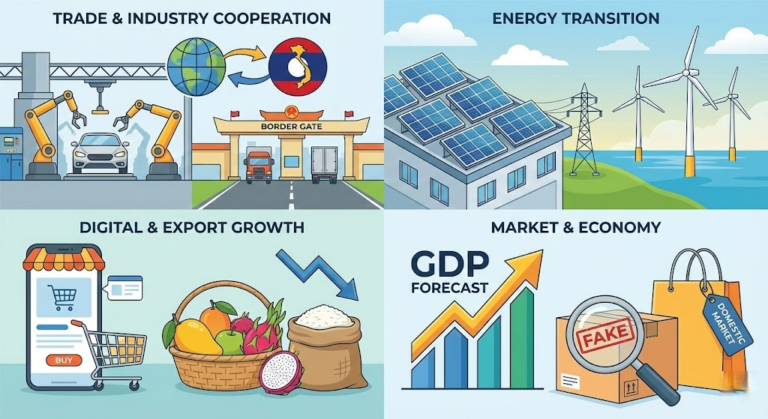
The Problem of Optimizing FDI Resources Entering the period up to 2030, the world economy is forecast to recover slowly with many potential risks. Meanwhile, megatrends such as the Fourth Industrial Revolution, digital transition, green transition, energy transition, and global supply chain restructuring are increasingly impacting industrial production.
Faced with this situation, developing Vietnam’s industry requires a strong change in the growth model, in which attracting “New Generation” Foreign Direct Investment (FDI) is identified as an important driver.

Analysis from VIOIT: According to the Vietnam Institute of Strategy and Policy for Industry and Trade (VIOIT), FDI attraction in the coming period must not stop at expanding capital scale but needs to shift strongly to quality, efficiency, and linkage.
- Focus: Anticipating investment flows with high technology, environmental standards, and modern governance.
- Target Sectors: High-tech industries, supporting industries, and stages with large value-added in the global production chain.
Parallel to that, the “New Generation” FDI attraction policy needs to be tightly linked with requirements for technology transfer, increasing the localization rate, and strengthening linkages between FDI enterprises and domestic enterprises. This is a key condition to gradually reduce dependence on the foreign investment sector while improving the autonomy and competitiveness of the national industry.
Strategic Orientations for Implementation To realize this goal, the Industry and Trade sector identifies several major orientations:
- Policy Perfection: Continue to perfect a synchronous, modern industrial development policy system adaptable to new trends. Policies need focus, prioritizing high-tech, emerging, and supporting industries. Strongly improve the business environment, accelerate the digitalization of administrative procedures, and ensure fair competition.
- Investment Promotion Innovation: Activities need to be proactive and selective, linked to the long-term development orientation of each industry and region. Forming large-scale industrial enterprises and groups capable of leading domestic supply chains is considered the foundation for raising Vietnam’s industrial position.
- High-Quality Human Resources: Training must be closely linked to practical business needs and new industrial trends; expand international cooperation to access advanced knowledge and governance methods; build a team of management and research officials capable of advising and organizing industrial policy implementation.
- Science, Technology & Innovation: The “New Generation” FDI policy needs to create a favorable environment for R&D and technology transfer, encouraging enterprises to undergo digital, green, and energy transitions. Specifically, attracting investment in producing high-tech materials, new materials, and domestic raw materials is seen as a key solution to reduce imports and increase value added.
- Market Expansion: Expanding export markets, strengthening trade remedies, and proactively participating in global production networks will create new development space for Vietnam’s industry.
Conclusion: On that foundation, the “New Generation” FDI attraction policy is not only a tool to attract capital but also becomes a driver for restructuring, elevating, and sustainably developing the national industry in the coming period.