Vietnam – Laos Industry: A “Special of Special” Linkage Model
Vietnam – Laos Industrial Linkage: A “Special of Special” Model
The Memorandum of Understanding (MoU) on developing the Vietnam – Laos industrial linkage chain opens a new framework to strengthen production connectivity between the two countries.
Recently, within the framework of the State visit to the Lao People’s Democratic Republic and attending the 50th Anniversary of the Lao National Day by General Secretary To Lam, high-level leaders of both countries witnessed the Handover Ceremony of cooperation documents. Notably, this included the MoU between the Ministry of Industry and Trade (MOIT) of Vietnam and the Ministry of Industry and Trade of Laos on developing industrial linkage chains.
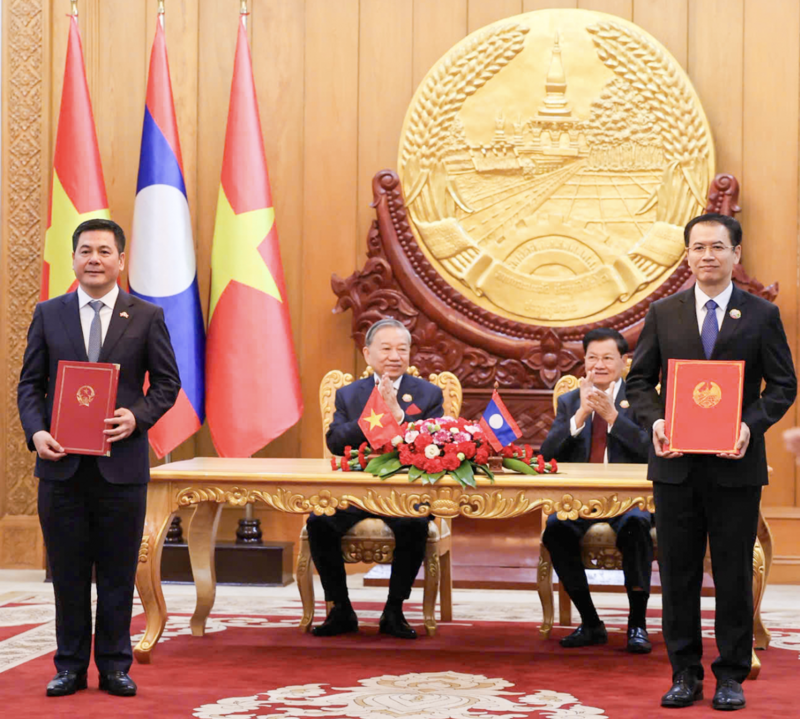
Significantly, both sides designated the Vietnam Institute for Industry and Trade Strategy and Policy (VIOIT) (under MOIT Vietnam) and the Institute of Industry and Commerce (IICE) (under MOIT Laos) as the focal points responsible for coordinating the implementation of this MoU.
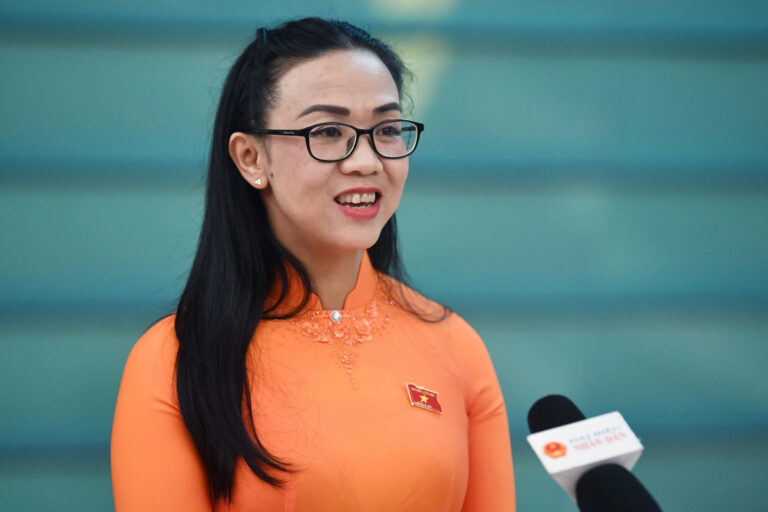
Industry and Trade Newspaper conducted an interview with Dr. Nguyen Van Hoi, President of VIOIT, regarding the implementation plan for this agreement.
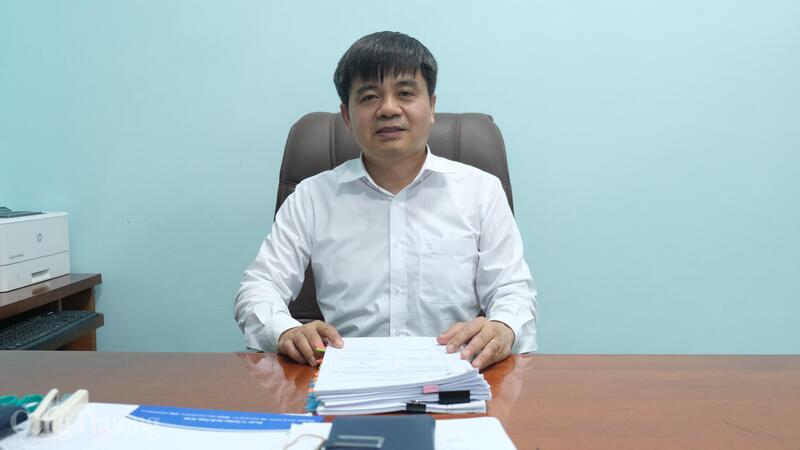
A “Special of Special” Memorandum Reporter: Sir, the Institute has been assigned the role of focal point for implementing the Vietnam – Laos industrial linkage chain. In your opinion, what are the key factors that need to be prioritized for the chain to operate effectively right from the early stage?
Dr. Nguyen Van Hoi: First of all, it must be affirmed that this is a “special of special” memorandum. It is very difficult to find in bilateral or multilateral commitments a document with a similar nature regarding industrial linkage as the one between the Ministry of Industry and Trade of Vietnam and Laos this time.
The main content of the MoU focuses on supporting enterprises of both countries to link across almost all industries: from materials, cement, iron and steel, chemicals, dairy, and fertilizers to electronics, textiles, footwear, and agro-forestry-fishery processing. An especially important pillar is cooperation and linkage in the energy industry, including solar power, wind power, and power transmission.
The key point of this linkage chain is supporting enterprises and supporting goods that are complementary to each other. The document does not stipulate rigid legal constraints but sets out important orientations: both sides support each other in building legal documents, sharing experiences, and coordinating the implementation of industrial development policies.
Within that, there is a breakthrough content: building a model of Vietnam – Laos Joint Industrial Parks. “Joint” here implies a synchronization of mechanisms, policies, operation methods, and management—meaning a very high level of compatibility—creating a favorable environment for enterprises of both countries to operate.
The larger goal is to create a foundation to boost bilateral trade turnover. Although Vietnam – Laos relations have the specific characteristic of being “special, faithful, and pure,” two-way turnover by 2024 is only around USD 1.6 billion, which is modest compared to the potential. The MoU is therefore expected to be the key to untying knots, from production and industry to hard and soft infrastructure.
This linkage chain focuses on connecting planning, technical infrastructure, logistics, and industrial zones, while simultaneously consolidating soft infrastructure such as preferential policies, trade-investment mechanisms, and encouraging technology transfer. Both countries currently possess the most preferential policies compared to other bilateral partners, but the important thing is the implementation stage, and the MoU serves as a common framework to ensure that.
The Institute will coordinate with relevant units to build a comprehensive implementation plan, covering all priority industries of both countries.
Creating Substantive Cooperation Between Enterprises Reporter: The MoU mentions piloting linkage models in priority industries such as agriculture, electronics, or renewable energy. On what criteria does the Institute plan to evaluate and select pilot models to ensure scalability?
Dr. Nguyen Van Hoi: The first step is to assess the current status, identifying existing issues and obstacles in the current industrial linkage between Vietnam and Laos. On that basis, a set of criteria for selecting pilot models can be formed.
- Needs Criterion: What does Vietnam need? What does Laos need? For example, Laos has advantages in raw materials—factors Vietnam critically needs for production and export. Conversely, Vietnam’s manufacturing strengths can support Laos in developing foundational industries.
- Enterprise Criterion: Besides scale, it is important that enterprises truly have a demand for cooperation and the potential to complement each other. The supply chain is only formed sustainably when businesses on both sides have motivation.
- Product Criterion: It is necessary to clearly identify which products are suitable for industrial production linkage, and which products have specific advantages for Vietnam and Laos, thereby choosing the right model to pilot.
- Market Criterion: The Vietnam – Laos linkage chain must first serve the domestic markets of both countries. However, the long-term goal is targeting the regional and global markets, especially as both countries desire deeper participation in the global value chain.
- Execution Mechanism & Legal Framework Criterion: Including taxes, customs, land, investment incentives, technology transfer, branding, and trade-investment promotion. Both sides must build a specific implementation roadmap: “First things first”, avoiding spreading resources too thin, ensuring efficiency.
On that foundation, the Institute will preside over building a detailed implementation plan, closely adhering to the MoU content and fitting the reality of both countries.
Training Linked to Reality Reporter: In the cooperation process, training and capacity building for Lao officials and enterprises are identified as an important pillar. How will the Institute design the training program to meet the exact needs of the Lao side, while supporting enterprises of both countries to participate deeply in regional and global supply chains?
Dr. Nguyen Van Hoi: Training and fostering officials is a content included in the MoU. And this time, the Institute aims for a completely innovative approach.
- First, training will be tightly linked with trade promotion, investment, and technology transfer activities between the two countries. It is not just theoretical training or organizing survey trips as before, but training linked to enterprise reality, building specific models.
- Example: Training on managing industrial zones, economic zones, border gate economic zone operation models, or training on product chain management and operation management of specific production lines. This helps Lao trainees apply knowledge immediately to management and production reality.
- Second, training is also an opportunity for Vietnam to grasp the thoughts, needs, and practical difficulties of the Lao side, thereby serving as a basis to guide Vietnamese enterprises to cooperate more effectively with their partners.
- Third, training will simultaneously support both state management and enterprises. This means Lao management officials are trained according to Vietnam’s model, while enterprises of both countries are guided on policy implementation, industrial promotion, trade, investment, and accompanying services.
Additionally, an important task is building a shared information system and database serving training and practical implementation. After each course, there must be specific products, including data, models, and practical reports for enterprises and management agencies of both countries to use immediately.
Training is not just a support task, but the foundation for Vietnam – Laos enterprises to participate deeper in the regional and global production network and supply chain, especially in the context of fluctuating global and regional supply chains.
Reporter: Thank you very much, Sir!
About VIOIT: The Vietnam Institute for Industry and Trade Strategy and Policy is a public science and technology organization under the Ministry of Industry and Trade, serving the state management of the Ministry, performing functions of research, strategy and policy development; postgraduate training; and professional training and fostering.